Natural Communication: Siemens and the shift to explaining “Why”
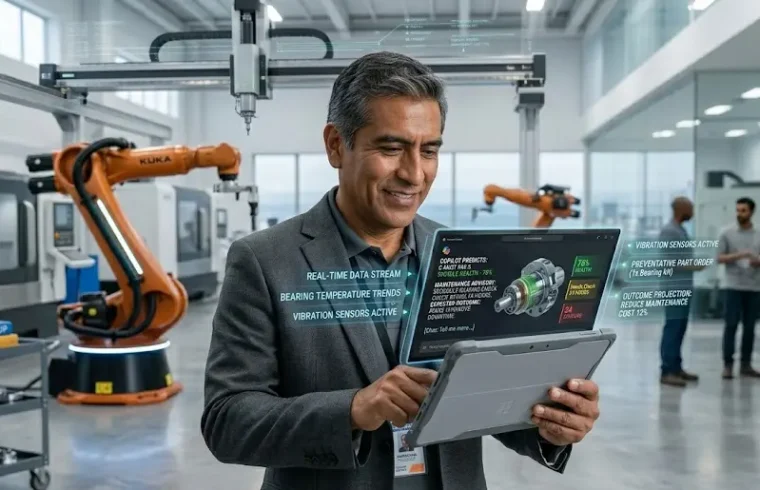
Siemens has long been a leader in predictive maintenance, but they are now evolving how their systems communicate with human staff. Instead of throwing cryptic alerts, their latest tools use AI to explain what is happening and why a specific signal matters. This allows engineers to understand the context of a potential failure without having to dig through layers of raw data immediately. Sometimes, this initial natural language explanation is all an expert needs to take corrective action.
Holistic Operations: ABB’s interconnected data sense-making
ABB takes a broader perspective by analyzing entire operations rather than isolated machines. Their AI tools connect different data points to understand how one issue might affect an entire interconnected system. By using Copilot to predict business outcomes, ABB translates this massive complexity into readable reports. This ensures that AI adds a layer of clarity to industrial operations rather than just another layer of complexity. For more on strategic AI integration, visit using Copilot to predict business outcomes to see how operations are being optimized.
Direct Interaction: GE’s move toward technician-focused data
General Electric is applying these tools to its industrial and aerospace divisions, allowing technicians to interact with data more directly than ever before. Rather than manually searching through old reports or dense manuals, technicians can ask the AI questions to get pointed in the right direction. While this does not replace human expertise, it significantly reduces the time lost in the orientation phase of a repair.
Physical Analysis: Gecko Robotics and AI-interpreted inspections
Gecko Robotics combines AI with physical inspection by using robots to collect data from infrastructure like pipes and tanks. Their advanced AI helps interpret these physical findings in a clear way. Instead of a simple report on corrosion, the system provides context and suggests next steps for the maintenance team. It is a physical application of AI that provides actionable guidance rather than just smarter alerts.
Accessible Data: Powergi and the future of plain-language insights
Powergi represents a newer group of players focused on making AI tools more accessible to a broader range of users. Their focus is on allowing users to ask questions in plain language to get useful insights without requiring a highly technical background. Although still developing, this approach illustrates the general industry trend toward making complex data easier to interact with.
Industrial AI Checklist for 2026:
- Prioritize systems that provide explanations and “why” context alongside alerts.
- Connect data points across entire operations to identify interconnected risks.
- Ensure AI tools act as a search-reduction layer for technicians and experts.
- Maintain a “double-check” habit for critical systems to manage potential AI errors.
- Focus on the human side by balancing AI suggestions with the deep expertise of veteran technicians.
Experience Insight: Generative AI becomes truly useful in industry when it shifts from being a monitor to being a guide. Success depends on overcoming messy data and building trust between humans and machines over time.